Dr Željko Kojadinović — NEUROHIRURGIJA I LEČENJE BOLA
Dr Zeljko Kojadinovic — Pain Treatment & Neurosurgery

When a Correct Diagnosis Begins to Shape — and Sometimes Limit — How Patients and Clinicians Interpret Symptoms and Clinical Findings
Author:
Dr. Zeljko Kojadinovic, MD, PhD
— Neurosurgeon
Specialized Experience:
30+ years of clinical experience in neurosurgery.
Last medically reviewed:
November 17, 2026
When a Correct Diagnosis Becomes an Incomplete Explanation
Receiving an accurate diagnosis is often a decisive moment in a patient’s life. It may end a prolonged period of uncertainty, explain previously unexplained symptoms, and provide access to appropriate treatment, rehabilitation, and professional support. A diagnosis can also bring reassurance by giving patients and their families a clearer understanding of the condition and its possible consequences.
For example, a cerebral cavernous malformation identified on MRI may explain a previous neurological event. A diagnosis of adhesive arachnoiditis may help explain persistent neuropathic pain and neurological impairment following a spinal disorder, surgery, or another intervention.
In both situations, the diagnosis may be entirely correct and remain essential for appropriate medical care. However, it does not necessarily explain every symptom, clinical sign, or abnormal investigation finding.
An established diagnosis may continue to provide valuable clinical guidance while also influencing how patients, families, and healthcare professionals interpret other information. Findings that appear compatible with the known disease may receive greater attention, while alternative explanations receive less consideration. Conversely, genuine consequences of the original disease may sometimes be underestimated when they do not fit an expected pattern.
The problem is not necessarily an incorrect diagnosis. It may be an incomplete explanation built around a correct one.
What Is the Diagnostic Framing Paradox?
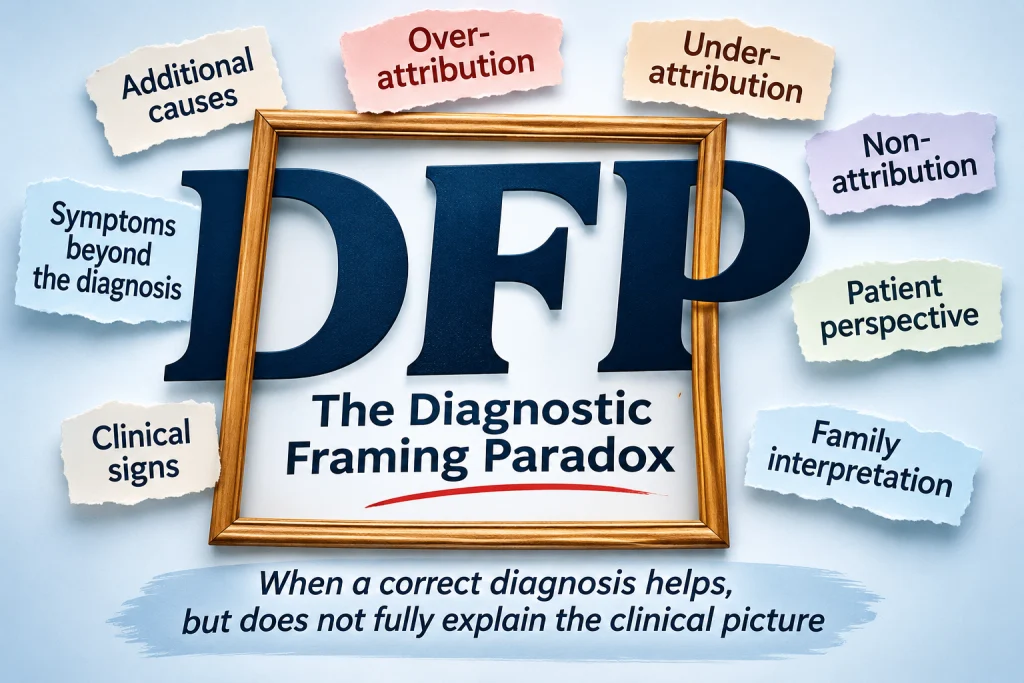
The Diagnostic Framing Paradox (DFP) is a proposed clinical concept introduced by Dr. Zeljko Kojadinovic to describe how an established and correct diagnosis continues to provide essential clinical guidance and understanding, while its influence on the interpretation of symptoms, clinical signs, and investigation findings may also contribute to over-attribution, under-attribution, or non-attribution.
The paradox lies in the coexistence of these benefits and potential disadvantages. The same correct diagnosis can remain essential for understanding and treating a disease, while excessive or overly narrow reliance on it may simultaneously contribute to errors in interpreting other aspects of the patient’s condition. Its clinical value is not diminished simply because the diagnostic framework may also create limitations.
This framing can arise early or develop gradually through repeated medical consultations, clinical documentation, personal experiences, treatment decisions, and information exchanged within patient communities. It may influence patients, families, and healthcare professionals, even when the original diagnosis remains entirely valid.
Three types of error may result.
Over-Attribution: When Everything Is Explained by One Diagnosis
Over-attribution occurs when symptoms or clinical findings are automatically assigned to an established disease without adequately considering other possible causes.
A known structural lesion, neurological disorder, or chronic pain condition may become the default explanation for complaints that arise later. Additional conditions may remain unrecognized, even when they are potentially treatable.
This can result in investigations being directed toward an incomplete explanation, ineffective treatment, or missed opportunities to address a separate problem.
Under-Attribution: When Genuine Disease Consequences Are Overlooked
Under-attribution occurs when genuine manifestations or consequences of an established disease are insufficiently recognized or dismissed.
This may happen when symptoms persist despite stable imaging, when neurological impairment is difficult to quantify, or when clinical findings do not correspond to an expected pattern of disease activity.
The absence of new disease activity does not necessarily exclude lasting effects of previous injury or continuing functional limitations attributable to the original condition.
Non-Attribution: When the Evaluation Stops Without an Explanation
Non-attribution occurs when symptoms or clinical findings are attributed neither to the established disease nor to any other cause, because the evaluation ends once the question defined by the diagnosis has been answered.
For example, when follow-up imaging shows that a known lesion is stable, new or persistent complaints may be considered unrelated to it, yet no further assessment of their cause is undertaken. The complaint is noted but left unexplained.
As a result, both genuine consequences of the disease and other treatable conditions may remain unrecognized. Non-attribution resembles premature closure, but it typically follows a correct diagnosis and a narrowly framed clinical question, rather than the acceptance of an incorrect explanation.
Over-attribution, under-attribution, and non-attribution are not mutually exclusive. They may occur in the same patient, simultaneously for different complaints or at different stages of the disease. Under-attribution and non-attribution may also affect the same complaint: a genuine consequence of the established disease may be overlooked, while the evaluation ends without any explanation for the complaint. Non-attribution can also occur on its own, when a complaint is correctly judged unrelated to the established disease but no alternative explanation is sought. Over-attribution and non-attribution may coexist when different components of a complaint are interpreted differently, or when one person attributes a complaint entirely to the established disease while another dismisses that connection without seeking an alternative explanation.
The aim is accurate attribution: assigning to the established diagnosis neither more nor less than its actual contribution, and identifying the cause of whatever it does not explain.
The Diagnostic Framing Paradox concerns errors shaped by an established diagnosis. Diagnostic errors that arise independently of that diagnosis fall outside its scope and are addressed by the broader literature on diagnostic error.
Clinical Example 1: Cerebral Cavernous Malformation
A cerebral cavernous malformation is a demonstrable vascular lesion that may cause hemorrhage, seizures, headaches, or focal neurological deficits. Its identification on MRI establishes a genuine anatomical abnormality, but does not automatically establish the cause of every complaint.
Consider a patient with a cerebral cavernous malformation who experiences recurrent headaches. Headaches may be related to the cavernoma itself, including possible effects of perilesional edema or mass effect, while headaches associated with hemorrhage or epileptic seizures represent distinct clinical mechanisms. The International Classification of Headache Disorders (ICHD-3) recognizes headache attributed to a cavernous malformation as a distinct secondary headache. Other mechanisms by which a cavernoma may contribute to headache may not yet be fully understood.
Headaches may also be indirectly related to the diagnosis or its treatment, including post-craniotomy headache, side effects of antiseizure medication, medication-overuse headache, or tension-type headache associated with anxiety following the MRI finding. Finally, they may be entirely independent of the cavernoma. ICHD-3 describes more than 200 distinct headache types, subtypes, and subforms. Primary headache disorders such as migraine and tension-type headache are diagnosed mainly by their clinical characteristics, even though their underlying mechanisms are not fully understood. Other secondary headaches, such as occipital neuralgia or cervicogenic headache, have identifiable causes. Several mechanisms may coexist in the same patient, and distinguishing between them matters because different headache disorders often require substantially different, and frequently effective, treatments.
Patients, family members, and clinicians may attribute headaches exclusively to the cavernoma, although it may account for them entirely, partially, or not at all. When it accounts for them only partially or not at all, this represents over-attribution: assuming that the cavernoma must explain the headaches completely may discourage investigation of other possible causes and potentially treatable contributing factors.
Non-attribution may also occur. When MRI shows a stable cavernoma, the headaches may be judged unrelated to it, and the consultation may end with that conclusion. The headaches are then neither attributed to the cavernoma nor diagnosed as a specific headache disorder, and the patient may receive no further assessment, referral, or targeted treatment. A patient who has been told that the headaches are „not caused by the cavernoma“ may therefore still live with an undiagnosed and untreated migraine, medication-overuse headache, or other treatable headache disorder.
One example of the opposite situation is a patient who has had a symptomatic hemorrhage from a brainstem cavernoma. Complaints such as imbalance, impaired coordination, spasticity, central neuropathic pain, sleep disturbances, or fatigue may result from the previous hemorrhage and brainstem injury. They may remain stable, fluctuate, worsen over time, or appear only weeks or months after the event. The same complaints may also have dozens of other possible causes; vestibular disorders, peripheral neuropathy, medication side effects, depression, anemia, and thyroid disease are only a few examples. These also need to be identified. Because follow-up MRI shows no new bleeding, the evaluation may end with the conclusion that the cavernoma is stable, even when new complaints have appeared. As a result, consequences of the previous brainstem injury may not be recognized and treated, and other, often additional, causes may not be identified. This combines under-attribution and non-attribution, and it may leave treatable problems unrecognized.
Whether the complaints result from the previous hemorrhage, from other causes, or from a combination of both, many of them can be treated, for example through physiotherapy and vestibular rehabilitation, occupational and cognitive rehabilitation, medication adjustment, treatment of sleep disorders, psychological support or psychotherapy, and management of coexisting medical conditions. Whether a complaint is “caused by the cavernoma” is therefore often less important than whether its actual cause has been identified and treated.
These examples illustrate three distinctions. A cavernoma may genuinely cause symptoms without being responsible for every complaint (over-attribution). The absence of new hemorrhage does not exclude persistent or newly emerging consequences of an earlier brain injury (under-attribution). And a stable MRI does not explain what is causing a complaint; when the evaluation ends there, the complaint may remain undiagnosed and untreated (non-attribution).
A practical application of this reasoning is discussed in my article on brain and spinal cavernous malformations.
Clinical Example 2: Adhesive Arachnoiditis
Adhesive arachnoiditis provides a different but equally instructive example. It is a chronic neurological condition that may be associated with persistent neuropathic pain, sensory disturbances, motor impairment, and substantial functional limitations. MRI may reveal nerve-root clumping or other characteristic abnormalities, although the relationship between imaging findings, neurological impairment, and the severity or distribution of pain is not always straightforward.
Once the diagnosis has been established, patients, families, and healthcare professionals may interpret virtually every subsequent pain complaint as another manifestation of arachnoiditis. This shared understanding can provide reassurance and guide appropriate care, but it may also discourage investigation of other contributing causes.
Over-attribution may occur when a patient with established arachnoiditis develops a separate pain generator, such as lumbar spinal stenosis, sacroiliac joint pain, hip pathology, peripheral nerve entrapment, or other musculoskeletal conditions, among many possible causes. Some of these conditions may develop independently, while others may be associated with changes in mobility, muscle function, posture, or mechanical loading related to arachnoiditis. If all pain is automatically attributed to the established diagnosis, additional conditions may remain unidentified despite the possibility of targeted treatment.
Under-attribution represents the opposite problem. Persistent neuropathic symptoms, neurological deficits, or functional limitations genuinely resulting from arachnoiditis may be underestimated when MRI shows no progression or when conventional investigations cannot adequately quantify the impairment. The absence of new structural changes on MRI does not exclude worsening symptoms caused by the established disease. Clinicians may underestimate the severity of deterioration or question its relationship to the disease because imaging findings remain unchanged. When this interpretation is communicated to family members, they may also begin to question the patient’s complaints, leaving the patient feeling disbelieved, unsupported, and increasingly isolated.
Non-attribution may arise when a new complaint or worsening of existing symptoms remains unexplained because unchanged MRI findings lead clinicians to consider the deterioration insignificant or unrelated, and the evaluation ends without adequately investigating its cause. For example, a patient may develop new focal hip or leg pain that is judged inconsistent with the known arachnoiditis. That assessment may be correct, yet hip pathology or peripheral nerve entrapment may remain undiagnosed because no further examination, investigation, or referral is undertaken. The complaint is left unexplained rather than incorrectly attributed to the established disease. The same hip pathology may therefore be missed in two different ways: by attributing the pain to arachnoiditis, or by correctly judging it unrelated to arachnoiditis without investigating its actual cause.
These situations may also affect the relationship between patients and clinicians. Patients who have experienced prolonged pain, repeated investigations, or difficulty obtaining recognition of their condition may perceive questions about the cause of individual symptoms as another dismissal of their suffering. Clinicians, meanwhile, may reasonably hesitate to attribute every complaint to arachnoiditis without sufficient evidence.
Uncertainty about the cause of pain does not mean that the pain is unreal. Nor does investigating additional pain generators invalidate the established diagnosis. However, when the discussion becomes focused on defending the established diagnosis or dismissing the patient’s complaints, attention may shift away from the more important task of identifying the causes of new or worsening symptoms, including both consequences of the established disease and additional potentially treatable conditions.
The key question is not whether the patient has arachnoiditis. The diagnosis may already be well established and continue to guide appropriate care. The question is whether it provides a sufficiently complete explanation of the patient’s current condition and whether additional treatable causes have been adequately considered.
Beyond Symptoms: Clinical Signs and Investigation Findings
The Diagnostic Framing Paradox is not restricted to subjective symptoms such as pain, dizziness, or fatigue.
An established diagnosis may also influence the interpretation of neurological signs, laboratory abnormalities, imaging findings, electrophysiological results, and other objective evidence.
Consider a patient with known polyneuropathy who develops progressive gait disturbance, asymmetric weakness, or new upper motor neuron signs. These findings should not automatically be interpreted as progression of polyneuropathy. They may indicate an additional disorder, such as cervical myelopathy when upper motor neuron signs are present, or lumbar spinal stenosis or radiculopathy when the clinical pattern suggests nerve-root involvement.
A careful neurological examination, appropriate MRI, and electrophysiological studies, including EMG and nerve conduction studies, may help distinguish the contributions of different conditions.
The reverse situation is also possible. When MRI findings remain unchanged, clinicians may underestimate new or worsening neurological symptoms or fail to recognize their possible relationship to the established disease.
Diagnostic framing can also influence how laboratory abnormalities are interpreted. A finding may be prematurely considered part of a known systemic disorder, although it could reflect an additional condition requiring separate evaluation.
Similar processes may occur in patients with cerebral arteriovenous malformations (AVMs), meningiomas, brain aneurysms, vestibular schwannomas, spinal stenosis, polyneuropathy, fibromyalgia, complex regional pain syndrome (CRPS), and many other conditions. Although the examples discussed here come primarily from neurosurgery and pain medicine, the Diagnostic Framing Paradox may occur across all medical specialties, wherever an established diagnosis influences how patients, families, and clinicians interpret new or worsening symptoms and clinical findings.
The underlying principle is the same: an established diagnosis should inform the interpretation of new clinical evidence without determining its meaning in advance.
Association with a known disease is not, by itself, proof of causation.
How Does the Diagnostic Framing Paradox Differ from Existing Concepts?
Anchoring Bias, Diagnostic Overshadowing, and the Diagnostic Framing Paradox
Anchoring bias is a general cognitive bias characterized by excessive reliance on an initial impression or piece of information, with insufficient adjustment when additional evidence becomes available. In medicine, it is predominantly discussed in relation to clinicians’ diagnostic reasoning. A physician may continue to favor an initial diagnostic interpretation despite subsequent findings that suggest alternative explanations. Anchoring bias is recognized as a potential contributor to diagnostic errors.¹
Diagnostic overshadowing occurs when an established condition leads clinicians to overlook other disorders or incorrectly attribute additional symptoms to that condition. The phenomenon was originally described in patients with intellectual disability whose psychiatric symptoms were overlooked or attributed to their existing disability.² Its application has subsequently expanded to other areas of medicine, where the presence of one recognized condition may interfere with the identification of another.
The relationship between these two concepts is close but not one of equivalence. Anchoring bias describes a cognitive mechanism, whereas diagnostic overshadowing describes a clinical phenomenon that may result from several mechanisms. Anchoring bias can contribute to diagnostic overshadowing when an established diagnosis becomes the dominant explanation for subsequent complaints. Lazris and Roth identify anchoring bias, premature closure, and implicit bias as major contributors to diagnostic overshadowing.³ These processes may persist or be reinforced through repeated consultations and prolonged periods of care.
The Diagnostic Framing Paradox (DFP) proposes an integrative clinical framework centered on the coexistence of two features: an established and correct diagnosis continues to provide essential clinical guidance, while excessive or overly narrow reliance on that diagnosis may simultaneously influence and sometimes limit the interpretation of symptoms, clinical signs, and investigation findings. The paradox does not imply that the diagnosis itself is harmful or that its clinical value diminishes over time. Rather, its continuing value may coexist with limitations arising from how it is used to interpret other aspects of the patient’s condition.
As described above, the framework encompasses three patterns of problematic attribution: over-attribution, under-attribution, and non-attribution.
The relationship of DFP to the two established concepts involves both overlap and differences. Over-attribution closely corresponds to diagnostic overshadowing and is not proposed as a new mechanism. Both involve excessive attribution of symptoms or findings to an established condition without adequately determining whether it accounts for them entirely, partially, or not at all. Under-attribution represents the opposite direction of attribution: instead of assigning too much explanatory weight to the established disease, its genuine consequences receive too little. Non-attribution describes a further problem in which a new, persistent, or worsening complaint remains unexplained because its cause is not adequately investigated.
Anchoring bias and premature closure may contribute to these patterns, although their roles may differ. Neither concept alone describes the entire framework proposed by DFP, which brings together different patterns of problematic attribution while recognizing that the established diagnosis remains correct and clinically useful.
The Role of Patients, Families, and Healthcare Professionals
From its initial formulation, the Diagnostic Framing Paradox explicitly encompasses clinicians, patients, and family members. Diagnostic framing is not confined to physicians’ clinical reasoning. Patients are active participants in understanding and interpreting their illnesses, while families and healthcare professionals may influence how an established diagnosis is understood and applied.
An established diagnosis may become central to how patients describe symptoms, make treatment decisions, search for medical information, and communicate with clinicians. This is often beneficial because it provides continuity, facilitates access to care, and helps patients understand their condition.
Families may adopt the same framework when interpreting changes in the patient’s health. Patient organizations and support communities may reinforce diagnostic understanding through shared experiences, educational resources, and practical advice. These processes can reduce isolation, improve recognition of poorly understood conditions, and help patients obtain appropriate medical attention.
At the same time, a familiar diagnosis may encourage new problems to be interpreted through the same framework before alternative explanations have been considered. Healthcare professionals may reinforce this tendency when assumptions about the causes of particular symptoms are carried forward from previous consultations into new medical reports, referrals, and treatment decisions without adequate reassessment. Such framing may arise early or become reinforced through repeated interactions over months or years. Over time, this may lead to what patients sometimes describe as “diagnostic resignation”: accepting new or worsening symptoms as an inevitable consequence of the established disease and no longer seeking potentially treatable alternative causes.
The interpretations of clinicians, patients, and family members may reinforce or conflict with one another. When they share an assumption that particular symptoms are caused by the established disease, alternative explanations may receive insufficient attention. Conversely, when clinicians question whether a complaint is related to that disease, patients may interpret this as questioning the reality or significance of their symptoms, even when that is not the clinician’s intention.
Another problem may arise when clinicians underestimate new or worsening symptoms because imaging findings remain unchanged. If this interpretation is communicated to family members, they may also begin to question the patient’s complaints or the severity of their deterioration. The patient may consequently feel disbelieved, unsupported, and increasingly isolated.
These processes do not imply that patients, families, or clinicians are deliberately making errors. They reflect the natural tendency to organize new information around an established explanation. However, the resulting interpretations may influence diagnostic decisions, communication, trust, and the support available to patients.
The important distinction is that the diagnostic framework can remain valuable and appropriate while excessive or overly narrow reliance on it may simultaneously contribute to an incomplete interpretation of particular clinical problems.
Recognizing and Avoiding the Diagnostic Framing Paradox
A useful question for both patients and healthcare professionals is:
„Would this symptom or finding be interpreted the same way if the established diagnosis were not already known?“
This question encourages reconsideration of clinical evidence without disregarding the original diagnosis.
For example, would recurrent headaches be interpreted differently if a cavernoma had not been discovered on MRI? Would new focal leg pain in a patient with arachnoiditis prompt consideration of a separate nerve or spinal disorder? Would progressive gait impairment in someone with polyneuropathy require investigation for an additional neurological condition?
Another useful question is whether apparently stable findings genuinely exclude persistent consequences of the original disease.
Reassessment is particularly important when symptoms change in character, distribution, frequency, or severity; when new neurological signs appear; when the clinical course differs from expectations; or when appropriate treatment fails to produce the anticipated improvement.
The process should begin with careful history-taking, neurological examination, and assessment of anatomical and physiological plausibility. Further investigations should be selected when they are likely to clarify an important uncertainty or influence management.
The purpose is not to question every established diagnosis, pursue unnecessary investigations, or assume that persistent symptoms must have an additional cause.
Instead, it is to determine whether the established diagnosis adequately explains each clinically significant problem, whether additional conditions may coexist, and whether genuine consequences of the original disease have been appropriately recognized.
The Diagnosis Should Guide Clinical Thinking, Not Replace It
A correct diagnosis and an incomplete explanation of a patient’s current condition can coexist.
This is especially relevant in neurosurgery, chronic neurological disorders, and persistent pain, where structural lesions, previous neurological injury, secondary functional changes, and independent conditions may contribute simultaneously to the clinical picture.
Some symptoms and findings may be direct consequences of the established disease. Others may be secondary, independent, or potentially treatable through a different approach.
Their relative contributions may vary between patients and change over time.
The Diagnostic Framing Paradox does not suggest that an accurate diagnosis becomes less valuable when additional problems are identified. On the contrary, recognizing the original disease remains essential for appropriate treatment and monitoring.
The paradox is that the same diagnosis can provide essential clinical benefits, while excessive or overly narrow reliance on it may simultaneously contribute to errors in interpreting other aspects of the patient’s condition.
Recognizing this coexistence may help preserve the benefits of diagnostic certainty while reducing the risk of overlooking additional treatable conditions or genuine consequences of the original disease.
The diagnosis should guide clinical thinking, not replace it.
Selected References
- Croskerry P. The importance of cognitive errors in diagnosis and strategies to minimize them. Academic Medicine. 2003;78:775–780.
- Reiss S, Levitan GW, Szyszko J. Emotional disturbance and mental retardation: diagnostic overshadowing. American Journal of Mental Deficiency. 1982;86:567–574.
- Lazris A, Roth A, Haskell H, James J. Diagnostic overshadowing: when cognitive biases can harm patients. American Family Physician. 2023;108(3):292–294.
Origin and First Public Presentation
The Diagnostic Framing Paradox was proposed by Dr. Zeljko Kojadinovic and first publicly presented on November 16, 2026, in the context of cerebral and spinal cavernous malformations. The concept was subsequently expanded to include non-attribution as a third pattern.
The original clinical example remains available on the author’s professional website. A dated archival snapshot documents that presentation.
The Diagnostic Framing Paradox is a proposed conceptual framework intended to encourage professional discussion and further evaluation. It has not been independently validated as a diagnostic model.