Dr Željko Kojadinović — NEUROHIRURGIJA I LEČENJE BOLA
Dr Zeljko Kojadinovic — Pain Treatment & Neurosurgery


Author:
Dr. Zeljko Kojadinovic, MD, PhD
— Neurosurgeon and Pain Management Specialist
Specialized Experience:
30 years of clinical expertise in neurosurgery
Last medically reviewed:
January 8, 2026
Why Is Brain Circulation So Important?
The brain is one of the most metabolically active organs in the body.
Although it represents only a small fraction of total body weight, it requires a constant and uninterrupted supply of blood to function normally.
Brain tissue has very limited energy reserves.
Even a short interruption of blood flow can lead to loss of consciousness, permanent brain injury, or death.
For this reason, cerebral circulation must deliver oxygen and nutrients continuously and efficiently.

Image: The intricate vascular architecture — a complex network of arteries and veins supplying the brain.

Image: Major cervical vessels — arteries transporting blood from the thoracic aorta to the brain, and veins draining venous blood back to the chest. Key vessels include the Carotid and Vertebral arteries, and the Jugular veins.
Arterial and Venous Circulation of the Brain
Brain circulation is divided into two complementary systems:
- Arterial circulation – delivers oxygen-rich blood to the brain
- Venous circulation – removes oxygen-poor blood and metabolic waste from the brain
Both systems must function properly to maintain normal brain activity.
Arterial Circulation of the Brain
The arterial system supplies the brain with oxygenated blood coming from the heart.
This system is organized into two major arterial pathways that connect at the base of the brain.
1. Internal Carotid Arteries (Anterior Circulation)
The internal carotid arteries are paired vessels that enter the skull through the carotid canal.
They supply the anterior and middle portions of the brain, including:
- the frontal lobes
- the parietal lobes
- large parts of the temporal lobes
- deep brain structures (such as the basal ganglia).
Major branches of the internal carotid arteries include:
- the anterior cerebral artery (ACA)
- the middle cerebral artery (MCA)
These arteries are responsible for blood flow to areas involved in movement, sensation, speech, and higher cognitive functions.

Image: Major cerebral arteries — the internal carotid arteries supplying the anterior circulation (front of the brain) and the vertebral arteries supplying the posterior circulation (back of the brain).
2. Vertebral Arteries and the Posterior Circulation
The vertebral arteries arise from the subclavian arteries and ascend through the cervical spine.
After entering the skull, the two vertebral arteries merge to form the basilar artery.
This system supplies the posterior circulation of the brain, including:
- the brainstem
- the cerebellum
- the occipital lobes (visual cortex)
Branches of the vertebrobasilar system are essential for:
- consciousness
- balance and coordination
- vision
- vital autonomic functions such as breathing and heart rate regulation
3. The Circle of Willis
At the base of the brain, the anterior and posterior arterial systems are connected by a vascular ring known as the Circle of Willis.
Its role is to:
- provide collateral blood flow
- help maintain circulation if one major artery becomes narrowed or blocked
However, the Circle of Willis is anatomically complete in only a portion of the population, and its protective function varies between individuals.
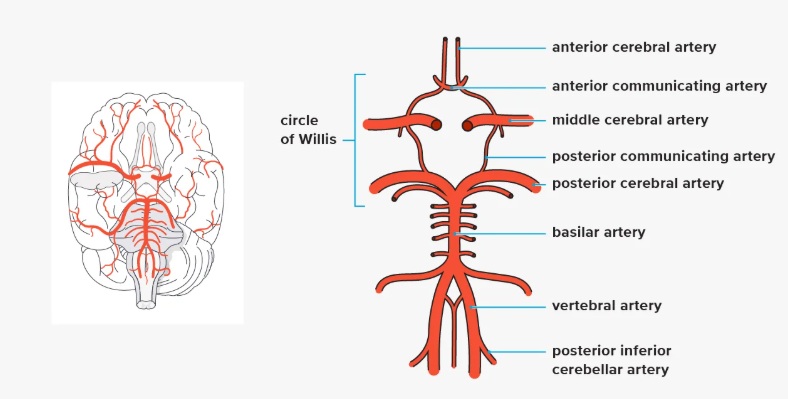
Image: Arteries at the base of the brain forming the Circle of Willis (Internal Carotid, Anterior Cerebral, Anterior Communicating, Posterior Cerebral, and Posterior Communicating arteries).
As cerebral arteries travel through the brain, they gradually branch into smaller vessels, eventually forming tiny arterioles and capillaries with very thin walls. It is at the level of these smallest blood vessels that the blood–brain barrier is formed.
The blood–brain barrier (BBB) is a protective filter formed by specialized cells lining the small blood vessels of the brain. Its role is to carefully regulate which substances can pass from the bloodstream into brain tissue, allowing oxygen and essential nutrients to enter while blocking many toxins, pathogens, and harmful molecules. This barrier is crucial for normal brain function, but it also explains why some medications do not easily reach the brain. In conditions such as inflammation, trauma, stroke, or infection, the blood–brain barrier may become partially disrupted, allowing substances to cross more freely and contribute to brain swelling or other complications. The integrity of the BBB is a key factor in how we manage brain edema (swelling) and choose medications for brain infections or tumors.
Venous Circulation of the Brain
The venous system drains deoxygenated blood and metabolic byproducts from the brain.
Blood flows from:
- superficial and deep cerebral veins
→ into large dural venous sinuses
→ and finally into the internal jugular veins
Unlike arteries, cerebral veins:
- have thin walls
- lack valves
- are highly dependent on pressure balance inside the skull
Proper venous drainage is essential for maintaining normal intracranial pressure.
Dural Venous Sinuses
Dural venous sinuses are large venous channels located between the layers of the dura mater.
They collect deoxygenated blood from the superficial and deep veins of the brain and serve as the main pathways for venous drainage.
Blood from the dural sinuses ultimately drains into the internal jugular veins.
These sinuses do not have valves, and their function depends on normal intracranial pressure and unobstructed flow, which is essential for maintaining healthy brain circulation.

Image: The cerebral venous system — veins draining blood from the brain into the dural venous sinuses, which converge to transport all venous blood into the internal jugular vein.
Clinical Importance of Cerebral Circulation
Disorders of cerebral circulation may result in:
- ischemic or hemorrhagic stroke
- transient ischemic attacks
- cerebral venous thrombosis
- increased intracranial pressure
- ruptured brain aneurysm
- spontaneous intracerebral hemorrhage
Understanding cerebral blood circulation helps explain many neurological symptoms and guides diagnostic and therapeutic decisions.