Dr Željko Kojadinović — NEUROHIRURGIJA I LEČENJE BOLA
Dr Zeljko Kojadinovic — Pain Treatment & Neurosurgery


Author:
Dr. Zeljko Kojadinovic, MD, PhD
— Neurosurgeon and Pain Management Specialist
Specialized Experience:
30 years of clinical expertise in neurosurgery and neurocritical care.
Last medically reviewed:
January 6, 2026
The subarachnoid space is a thin, fluid-filled space that surrounds the brain and spinal cord.
It lies between two protective layers of the brain coverings (meninges) and plays a key role in cushioning and protecting the nervous system.
Where is the subarachnoid space located?
The brain and spinal cord are covered by three layers called meninges:
- Dura mater – the tough outer layer
- Arachnoid mater – the delicate middle layer
- Pia mater is the thin inner layer that lies directly on the brain surface.
There is no space between the brain and the pia mater — when the brain is seen, what you see covering it is the pia mater itself.
👉 The subarachnoid space is located between the arachnoid mater and the brain surface.

Image: The subarachnoid space is shown between the arachnoid layer (one of the brain’s protective membranes) and the brain itself (covered with pia mater). It is filled with cerebrospinal fluid (CSF), a clear liquid that cushions the brain and spinal cord. This space is crisscrossed by delicate connective tissues called trabeculae and contains the brain’s blood vessels. The subarachnoid space follows the contours of the cerebral cortex, extending into the sulci (the grooves or folds between the ridges of the brain known as gyri).
What is inside the subarachnoid space?
The subarachnoid space contains:
- Cerebrospinal fluid (CSF) – a clear fluid that cushions the brain. It is continuously produced within the ventricles (four interconnected cavities inside the brain: the two lateral ventricles, the third, and the fourth ventricle). From there, the CSF flows out of the ventricles and enters the subarachnoid space, where it circulates around the entire brain and spinal cord, providing buoyancy and waste removal.
- Major blood vessels supplying the brain
- Nerve roots (especially along the spinal cord)
This space allows the brain to “float” and reduces the impact of everyday movements or minor trauma.

Image: The subarachnoid space is shown between the spinal cord, the spinal nerves, and the arachnoid membrane. Cerebrospinal fluid (CSF) flows through this space, and spinal nerves pass through it before they receive their individual nerve coverings.
Why is the subarachnoid space medically important?
Problems involving the subarachnoid space are often clinically significant because this space contains both CSF and blood vessels.
Common conditions include:
- Subarachnoid hemorrhage (SAH) – non-traumatic bleeding into this space
- Traumatic subarachnoid hemorrhage (tSAH) after head injury
- CSF circulation disturbances
- Inflammation or infection affecting the meninges
Even small changes in this space can cause symptoms such as headache, neck stiffness, or altered consciousness.
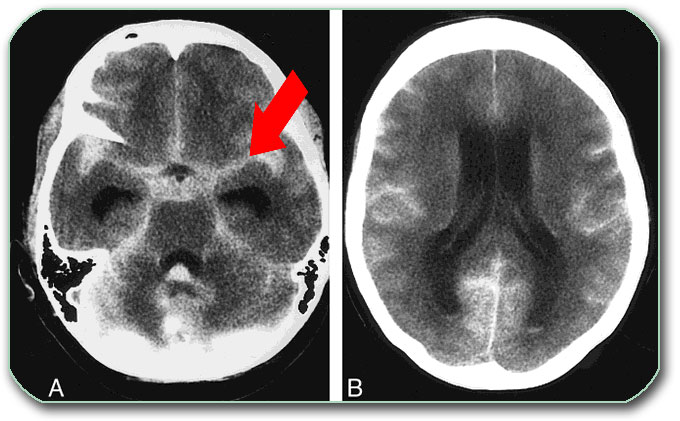
Image: Brain CT showing blood in the subarachnoid space. Fresh blood appears white (red arrow).
How does bleeding occur in the subarachnoid space?
Bleeding into the subarachnoid space happens when a blood vessel, an aneurysm, or an arteriovenous malformation (AVM) ruptures.
This can occur due to:
- Head trauma (traumatic SAH)
- Ruptured brain aneurysm or AVM (non-traumatic SAH)
The presence of blood irritates the brain coverings and may increase intracranial pressure.
Is the subarachnoid space the same as brain ventricles?
No.
They are connected but not the same.
- Ventricles are cavities inside the brain where CSF is produced
- The subarachnoid space surrounds the brain and spinal cord and allows CSF to circulate
Both are part of the normal CSF system.
Related topics
- Traumatic subarachnoid hemorrhage (tSAH)
- Cerebrospinal fluid (CSF)
- Intracranial pressure (ICP)
- Brain meninges explained
- Ruptured brain aneurysm and SAH
- Spontaneous CSF leak